Dada Shkurte
December 2023 — Broliq
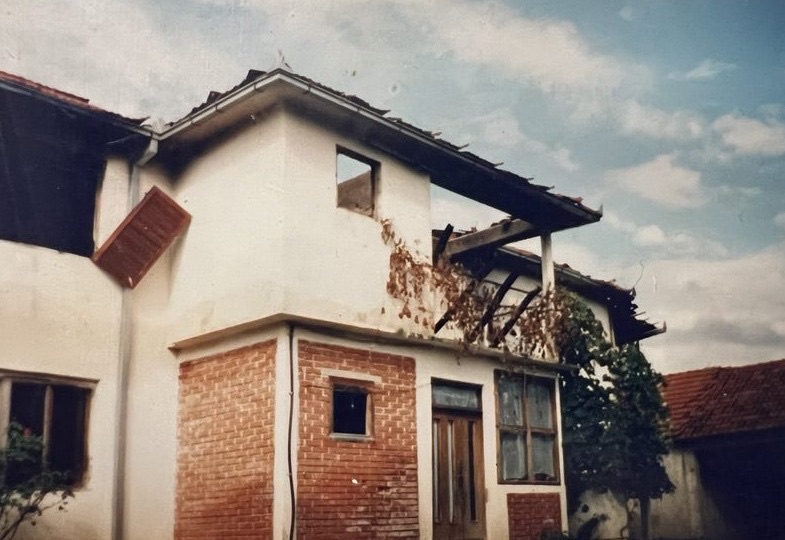
Albanian:
“Na vetë, me Bacën Tem, unë shkojsha me Bacën Tem e ju nimojsha mi pastru varrët”
“We did, us women, with my uncle, your father. I used to go upstairs to help him, and us women helped clean all the patients’ wounds.”
Below is the a creative, non-fiction vignette written by Erjona Gashi about Dada Shkurte’s interview.
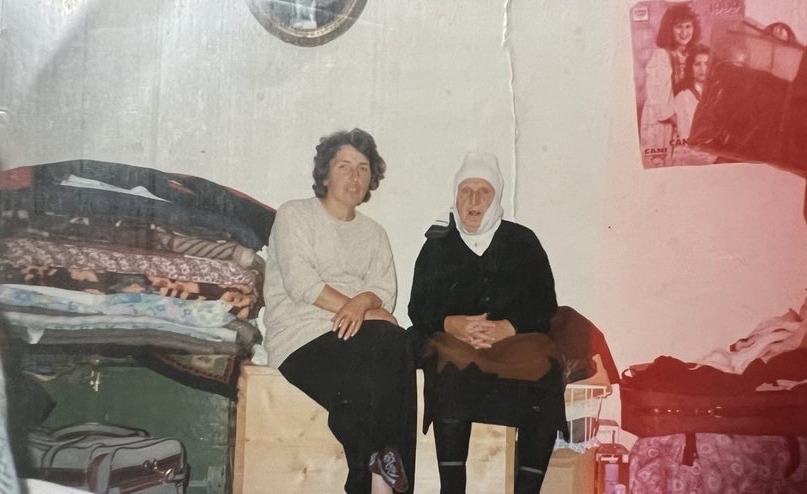
When I went to Kosova over winter break, I visited Broliq and sat with my aunt Shkurta, my uncle Demush, their daughters, Besiana, Violeta, and Alba, all of their children and all of my siblings and nudged the conversations towards wartime. What I call Dada Shkurte’s story below is actually a mix of Dada Shkurte’s perspective as well as her daughters who continuously jumped to correct Dada Shkurte or added details to her recollection of war. I constructed her story based on my memory and some notes that I took on my phone right after leaving Broliq that day.
Data Shkurte said they never starved. They carried flour, milk, cheese, honey from my uncle’s bees. People also left flour behind, on the side of the road, so others could use it.
They had pots, and pans, a shovel, and some tools to make fire.
Most of the time Dada Shkurte baked bread.
Other times, pancakes. Sometimes gurabija.
She baked on the side of the road, kneeling by the fire as the men walked ahead in the endless column, gathering wood with hands cracked and raw.
My uncle baked too. Once, he made three or four loaves and passed them through the other tractors, breaking pieces into open hands. They chewed in silence. They said they had never tasted bread as good as that night, perhaps hunger itself had sharpened the flavor.
Before they fled, they freed our cows. The whole village did the same. They unlatched the gates, sent the cows wandering into the hills. Laha set loose his two hundred sheep too.
But one man refused to leave his home, his daughter, his sheep. His sheep were his life, his fortune, his duty. So, his daughter stayed, too.
When the paramilitary came to Broliq, Dada Shkurte said we were already gone. But he was there. They found him, his daughter, and his five hundred sheep. They killed them all together—father, daughter, and flock. The villagers told them later that she had hidden five thousand marks in the folds of her dress. When the internationals performed the autopsy, the money was still there, stiff with blood, pressed against her skin.
She carried it with her into the grave. The money wasn’t enough to save their lives.



 Zëri i Grave