Ajmone
January 2024 — Remote
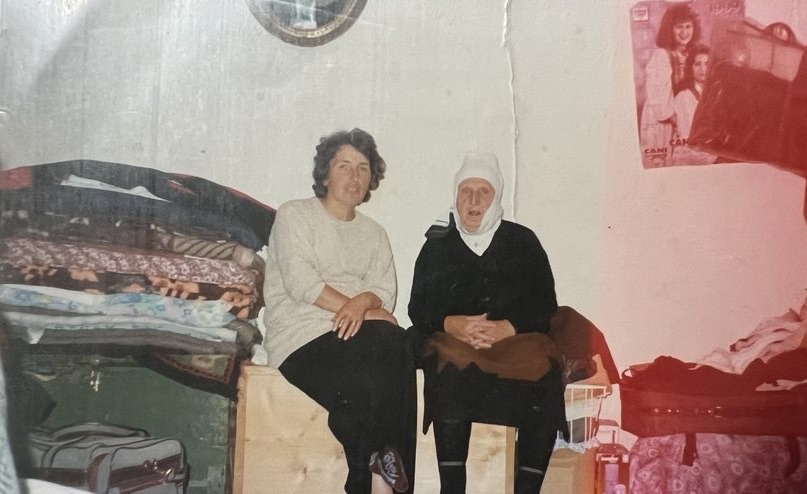
Albanian:
“Atë natë tanë natën na majtën durtë lidhun, tanë natën, herë u ulsha n’karrigë herë u qojsha n’kamë. ”
“Our hands were tied all night. I couldn’t sleep. I walked around the small room all night. I thought I heard my father-in-law talking to me, and I heard my children screaming and crying, I thought I’d never survive that night.”
Below is the a creative, non-fiction vignette written by Erjona Gashi about Ajmone’s interview.
It started with a message.
A casual WhatsApp exchange with my aunt, halla Ajmon, turned into something else—a request, a reckoning. Halla wanted to share her story too.
I hesitated, my fingers hovering over the keyboard. I had asked about the war before, in fleeting moments, but this—this was different. This was an invitation to peel back another layer of my family’s history. Was I prepared to hear things I didn’t want to hear? What if Halla’s voice cracked, what if the weight of it all became too much for her? What if she broke down in tears? How would I comfort her from thousands of miles away?
I swallowed the uncertainty and typed: Would Friday work for you?
Halla:
In Broliq, your father’s house was brimming with people—refugees from Kotrodiq and Vranoc. You wouldn’t have recognized a single familiar face. The house overflowed, bodies glued together, spilling onto the balcony. There was no sleep. We rested where we could, on thin foam pads that barely cushioned the cold floor.
Us women—God, us women—never stopped moving. We baked bread in shifts, kneading dough with tired hands, churning out loaves as if they could stretch time itself. We rolled pastries, gurabija, rationed flour. We didn’t speak of fear out loud, but you could see it in our movements—the pace, the silent glances, the worry that one day, there would be nothing left to give.
Your grandmother was at the center of it all.
She welcomed refugees and each patient your father brought in, found them a place to sit, to rest—however briefly. She commanded the women, told them what needed to be done.
There was always something to be done.
And then there were the wounded.
Rexhep Sadrija arrived with a bullet lodged in his leg. Your father and sister tended to his wounds, while your cousin Violeta carried his bloodstained clothes to the well, washing away the evidence of war as best she could.
Others came from Junik. One man, so young, had a bullet in his head. Your father tried to care for him, and your cousins took him outside for air when the walls felt too tight. I don’t remember his name now—imagine that. A man with a bullet in his head, and we’ve forgotten his name.
“We have grown to forget how much we suffered.”
I stared at the screen, the words getting to me, making it hard to breathe.
To think, she said, that we have grown to forget. But I hadn’t. Not yet.
And now, neither would she.


 Zëri i Grave